Restaurant and Cafe Printing Guide: Menus, Table Tents, Takeaway Bags
Restaurant and cafe printing in Dubai centers on a core set of items: menus that customers hold and read closely, table tents and counter cards that promote specials without needing a server to explain them, and takeaway bags and food packaging that carry the brand beyond the door. Each item has different practical demands, print frequency and durability needs, so treating them as one generic "restaurant print" order usually leads to the wrong stock or finish being used somewhere.
This guide covers what to order for each part of a restaurant or cafe, how often to expect to reprint, and where branding actually gets noticed by customers.
Why Does Restaurant Printing Need Its Own Approach?
Unlike a typical office's stationery, restaurant and cafe print is handled constantly by customers and staff, often with food and drink nearby, and it needs to be replaced more frequently as menus change and items wear out. A menu printed on the wrong stock can look tired within weeks, and a table tent that isn't easy to update becomes stale the moment a promotion changes. Planning for this cycle, rather than treating restaurant print as a one-time order, keeps the space looking current.
Menus
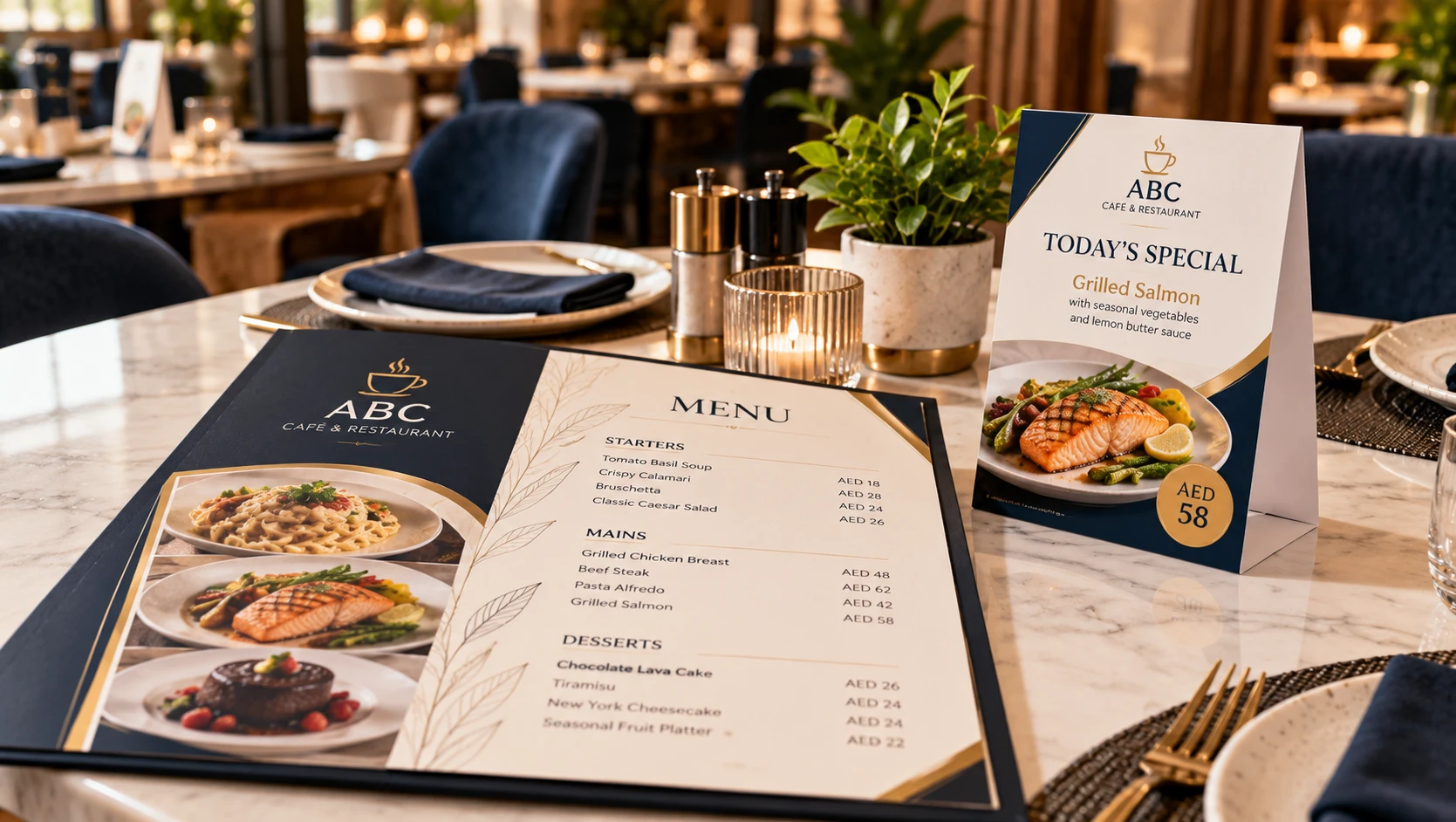
A menu is handled directly and closely by nearly every customer, so it needs a stock that feels good in hand and survives regular use. Laminated or heavier stock with a wipeable finish suits a menu that's used repeatedly over months, while a lighter, more frequent reprint approach suits a cafe or restaurant that changes its offering seasonally or often. See Brochures & Catalogues for multi-page menu formats and Business Cards style single-sheet options for a simple, single-page menu.
Decide your update frequency before choosing a finish. A heavily laminated menu is more durable but more expensive and slower to update than a simpler, cheaper sheet meant to be reprinted every few months as the menu changes.
Table Tents and Counter Cards
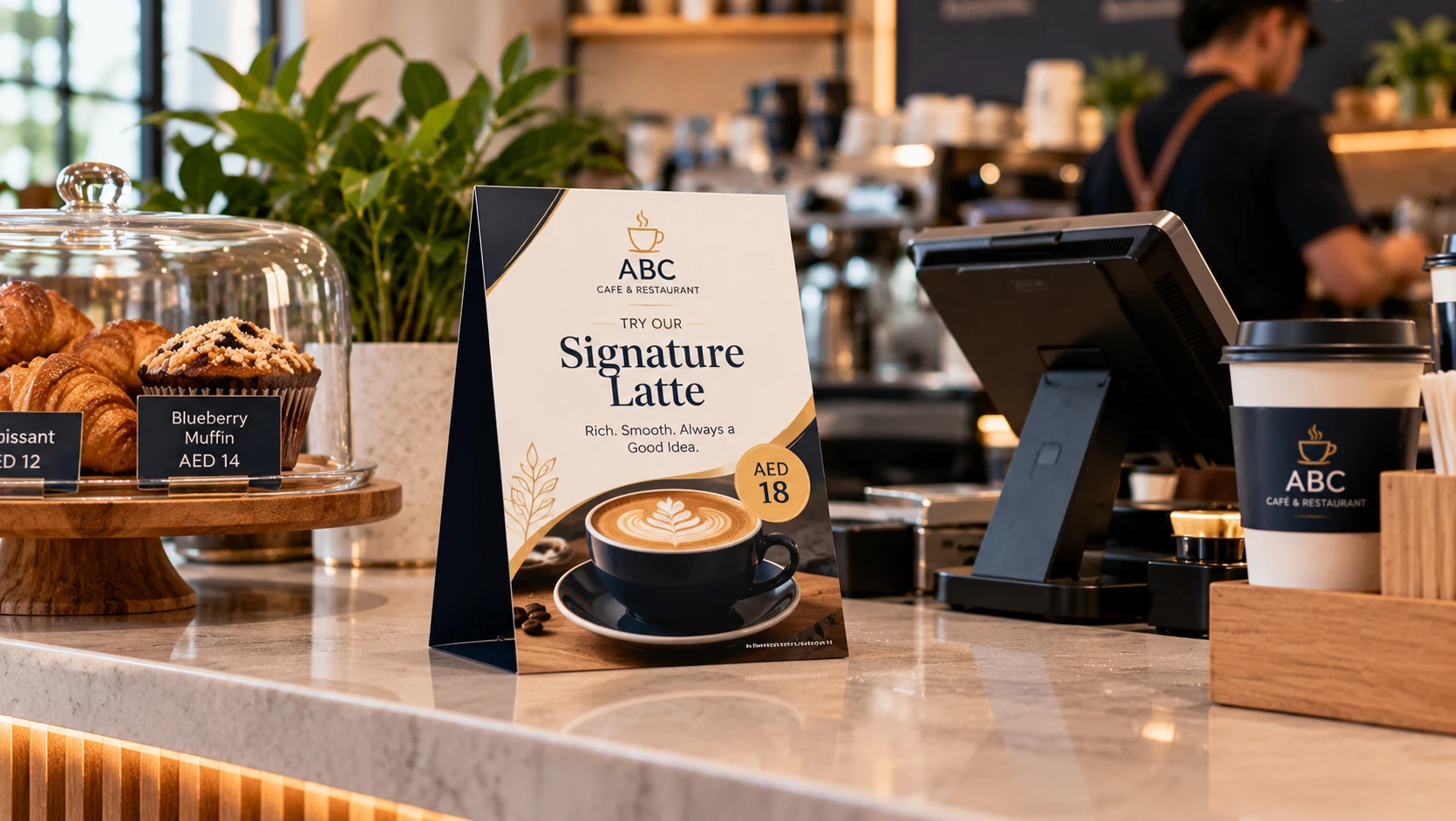
Table tents sit on the table and promote a specific item, a special, a new dish, or an upsell, without relying on a server to mention it. Counter cards do a similar job at the till or counter, prompting an add-on purchase at the point of ordering. Both are typically small, printed on a rigid card stock that stands upright, and are changed more often than a full menu since they're used for short-term promotions. See Business Printing for card stock options suited to this format.
Takeaway Bags and Food Packaging
For any restaurant or cafe offering takeaway or delivery, the bag or box is a branding opportunity that travels well beyond the premises, often photographed and shared on social media by customers. Printed paper bags, branded burger or bakery boxes, and food-safe wrapping all extend your presence past the point of sale. See Food Packaging and Paper Bags for food-grade material options.
Confirm food-safety compliance for any packaging that comes into direct contact with food, since this involves specific material and coating requirements beyond standard printing. [CONFIRM: food-safety-compliant materials]
Designing a Menu That Actually Sells
Beyond the print specification, how a menu is laid out affects what customers order, which is worth considering alongside the print itself. Items placed at the top of a section or set apart with a border or icon tend to get noticed first, and a menu with too many items on one page can make decisions harder rather than easier, which can slow down table turnover. If you're redesigning a menu, it's worth thinking about layout hierarchy at the same time as choosing paper stock, since both affect the customer experience.
Photography is a related decision. A menu with a few well-shot photos of signature dishes can help sell them, but a menu covered in low-quality images across every item often looks cluttered and can read as less premium than clean typography with well-chosen section headers. Decide whether photography fits your restaurant's style before committing it to every page.
Staff Uniforms and Branded Wear
Print and packaging aren't the only branding touchpoints in a restaurant or cafe. Staff aprons, chef wear and branded polo shirts extend the same visual identity from the menu and packaging onto the people customers interact with directly. See Apparel & Uniforms for staff clothing options that can be branded to match your print materials.
Signage and Window Graphics
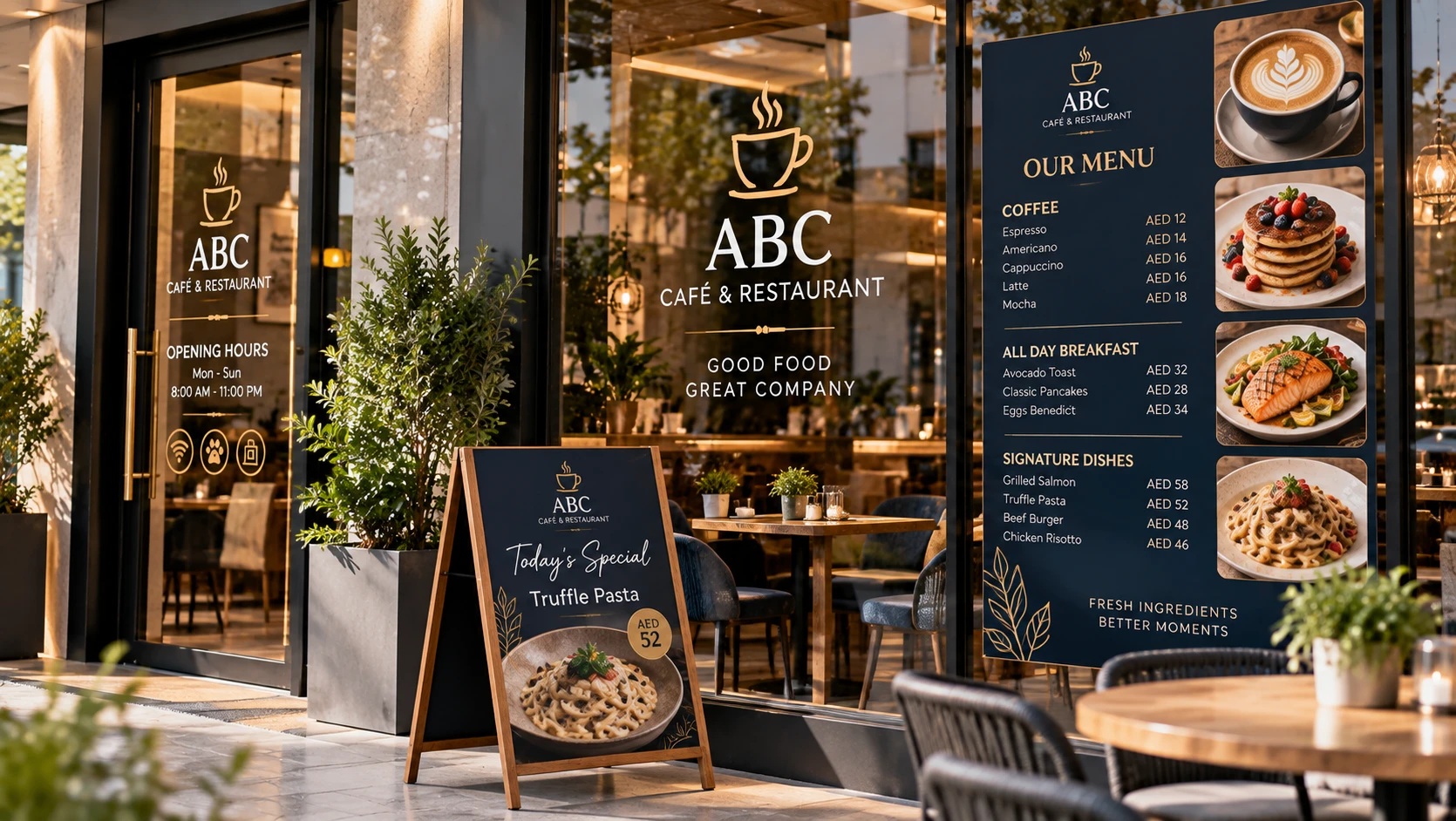
A visible menu board, an opening-hours sign, or a window graphic announcing your offering helps a restaurant or cafe get noticed by passers-by before they even step inside. See Wall & Floor Graphics for window and entrance options, and check Signage Approval requirements if you're adding exterior signage.
How Often to Reprint?
Menus that change seasonally are typically reprinted every few months, while a fixed core menu with occasional specials might only need a full reprint once or twice a year, supplemented by table tents or insert cards for specials in between. Table tents and counter cards, since they promote short-term offers, are often reprinted monthly or even more frequently. Takeaway packaging is typically ordered in larger batches less often, since it's a higher-volume, lower-per-unit item. Planning your reprint cycle for each item separately avoids either running out unexpectedly or holding a large stock of soon-to-be-outdated menus.
Bilingual Menus
Many UAE restaurants offer menus in both English and Arabic, and this needs the same careful layout attention as any bilingual print, since Arabic runs right to left and needs its own properly typeset section rather than a direct mirror of the English layout. See our bilingual print design guidefor layout rules that keep both languages reading naturally.
Seasonal and Limited-Time Menus
Many UAE restaurants and cafes run seasonal menus around Ramadan, National Day, or a summer or winter offering, and these need their own short print cycle separate from the core menu. A simple insert card or a dedicated seasonal table tent works well here, since it avoids reprinting the full core menu for a temporary addition. If you run a Ramadan iftar menu, our Ramadan and Eid printing guide covers invitations and gifting alongside your seasonal print needs.
Budgeting for Restaurant Print
Because menus, table tents, and packaging are reprinted at different frequencies, it helps to budget for restaurant print as a recurring line item rather than a one-time cost. A modest, regular reprint budget for table tents and seasonal menu updates, alongside a larger, less frequent budget for full menu reprints and packaging batches, tends to keep costs predictable across the year rather than arriving as a series of unplanned expenses.
Consistency Across the Customer Experience
A menu, table tent, takeaway bag, and window sign that share the same fonts, colors, and logo placement reinforce the brand at every touchpoint, from the street to the table to the bag a customer carries home. Keep a master brand file with your approved logo, colors, and fonts so every reprint, whatever the item, stays visually consistent even as individual pieces are updated on different schedules.
Delivery Platforms and Packaging Requirements
If your restaurant works with third-party delivery platforms, check whether they have their own packaging or labeling requirements alongside your own branding choices, since some platforms specify tamper-evident sealing or particular labeling for food safety and order accuracy. Build any such requirement into your packaging design from the start, rather than adding a platform sticker as an afterthought over an otherwise finished design. [CONFIRM: delivery platform packaging requirements]
Common Restaurant Printing Mistakes to Avoid
- Choosing one stock for everything.A menu, a table tent, and a takeaway bag all have different durability needs.
- Reprinting the whole menu for a single special. Use a table tent or insert card instead, and save the full reprint for a genuine menu change.
- Ignoring food-safety requirements for packaging. Confirm compliant materials for anything in direct food contact.
- Inconsistent bilingual layout. Follow proper Arabic-English layout rules rather than a direct mirror of the English menu.
- No plan for reprint frequency. Budget and plan for menus, table tents, and packaging on their own separate cycles.
Frequently Asked Questions
Q. What stock should I use for a laminated menu?
Ans. A heavier, laminated stock suits a menu used repeatedly over months. See Brochures & Catalogues for options.
Q. How often should I reprint table tents?
Ans. Often, since they typically promote short-term specials. Many restaurants reprint monthly or as promotions change.
Q. Can you print food-safe takeaway packaging?
Ans. See Food Packaging for options, and confirm compliant materials for your specific use.
Q. Do I need a permit for exterior restaurant signage?
Ans. Generally, yes, for exterior signage. See our signage approval guide for details specific to your location.
Q. Can menus be printed in both English and Arabic?
Ans. Yes, following proper bilingual layout rules. See our Arabic-English bilingual print design guide for details.
Get Your Restaurant Print Sorted
Plan menus, table tents, and packaging on their own reprint cycles, and keep a consistent brand across all of them. For restaurant and cafe printing in Dubai, see our Business Printing and Packaging pages, or message us on WhatsApp with your menu and volume.