Event Printing Timeline: Weddings, Conferences and Product Launches
An event printing timeline for a wedding, conference, or product launch generally works backwards from the event date, with different items needing different lead times. Invitations and save-the-dates go out earliest, followed by signage and stationery for the day itself, with name badges, place cards, and last-minute materials confirmed closest to the event. Treating every item as needing the same lead time is the most common reason event print goes wrong, since some pieces genuinely need weeks and others can be finalized days before.
This guide sets out a practical timeline for three common event types, what to order at each stage, and how to avoid the rush that catches most first-time event organizers out.
Why Does Event Print Need Its Own Timeline?
Unlike ongoing business printing, event print is tied to a single fixed date that can't move, which makes lead time planning more critical than for stationery you can reorder at any point. A wedding invitation printed too late misses guests who needed advance notice to travel or arrange leave. A conference badge with a wrong name printed the morning of the event is a scramble no organizer wants. Planning backwards from the date, rather than forwards from when you happen to start, is the difference between a smooth event and a stressful one.
Weddings: A Sample Timeline
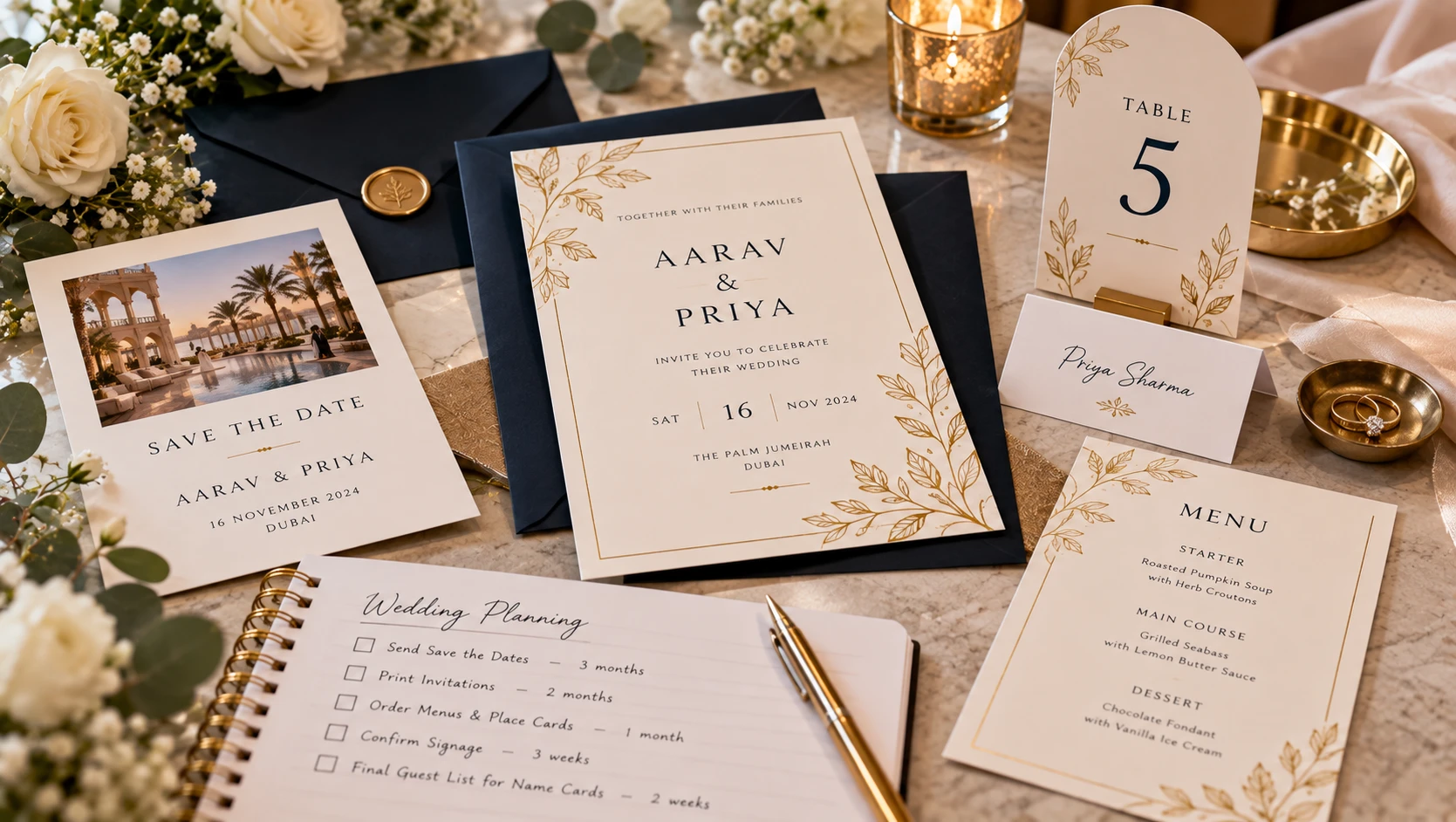
Save-the-dates typically go out several months ahead, especially for guests travelling internationally, a real consideration in the UAE's diverse expat community. Formal invitations follow, usually with enough lead time for guests to respond before final catering and seating numbers are needed. Closer to the day, order table plans, place cards, menus, and any signage for the ceremony or reception venue. See Envelopes for invitation envelopes and Business Printing for cards and stationery.
Confirm exact lead times for invitation printing and any specialty finishes, such as foil or letterpress, since these premium touches typically need longer production time than standard printing.
Conferences: A Sample Timeline
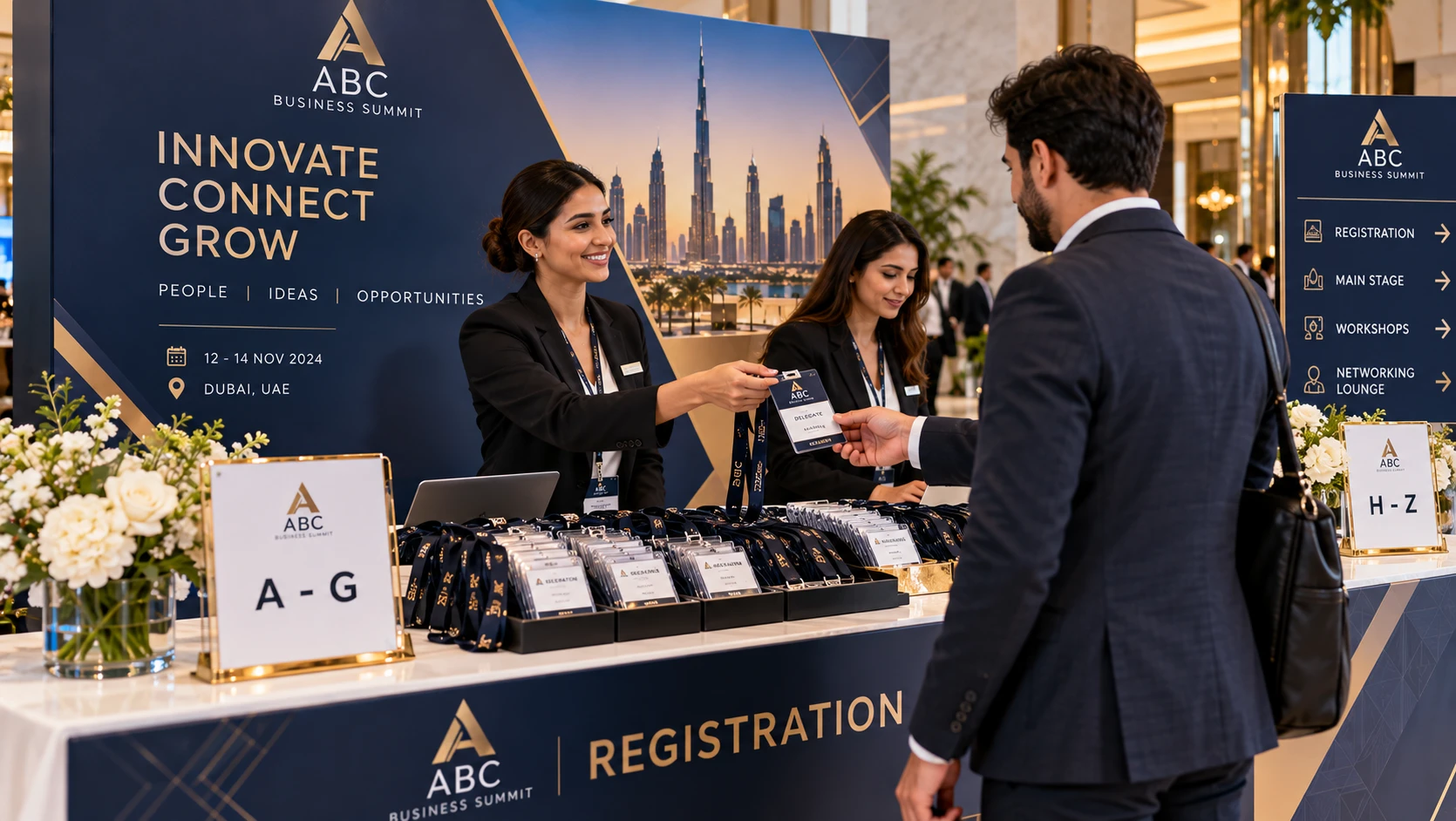
For a conference, registration signage, banners, and backdrop graphics for the main stage or entrance are usually ordered several weeks ahead, similar to exhibition timing. Delegate badges, often personalized with names and sometimes QR codes, are typically finalized closer to the event once registrations are confirmed, since late registrations are common right up to the final days. Printed agendas, speaker bios, and any handout material can follow a similar late timeline, since content often isn't final until close to the date. See Badges & Lanyards and Roll-Up Banners.
Product Launches: A Sample Timeline
A product launch typically needs backdrop or stage graphics, branded signage, and printed material about the product itself, brochures, spec sheets or press kits, ordered on a timeline similar to an exhibition, several weeks ahead for large-format items. For press or guest invitations, if the launch is invite-only, follow a timeline closer to a formal event invitation, while giveaways or press kits are often finalized last, once the final product details and messaging are locked. See Banners & Signage and Brochures & Catalogues.
Corporate Events: Internal Launches and Milestones
Beyond public-facing conferences and launches, many UAE companies run internal events, an anniversary celebration, a townhall, and an internal product reveal that need their own scaled-down version of this timeline. Signage, name badges, and a small amount of branded merchandise are usually enough for an internal event, without the fuller press kit and public marketing material a public launch requires. See Corporate Gifts for merchandise suited to internal celebrations and staff events.
A General Lead Time Framework
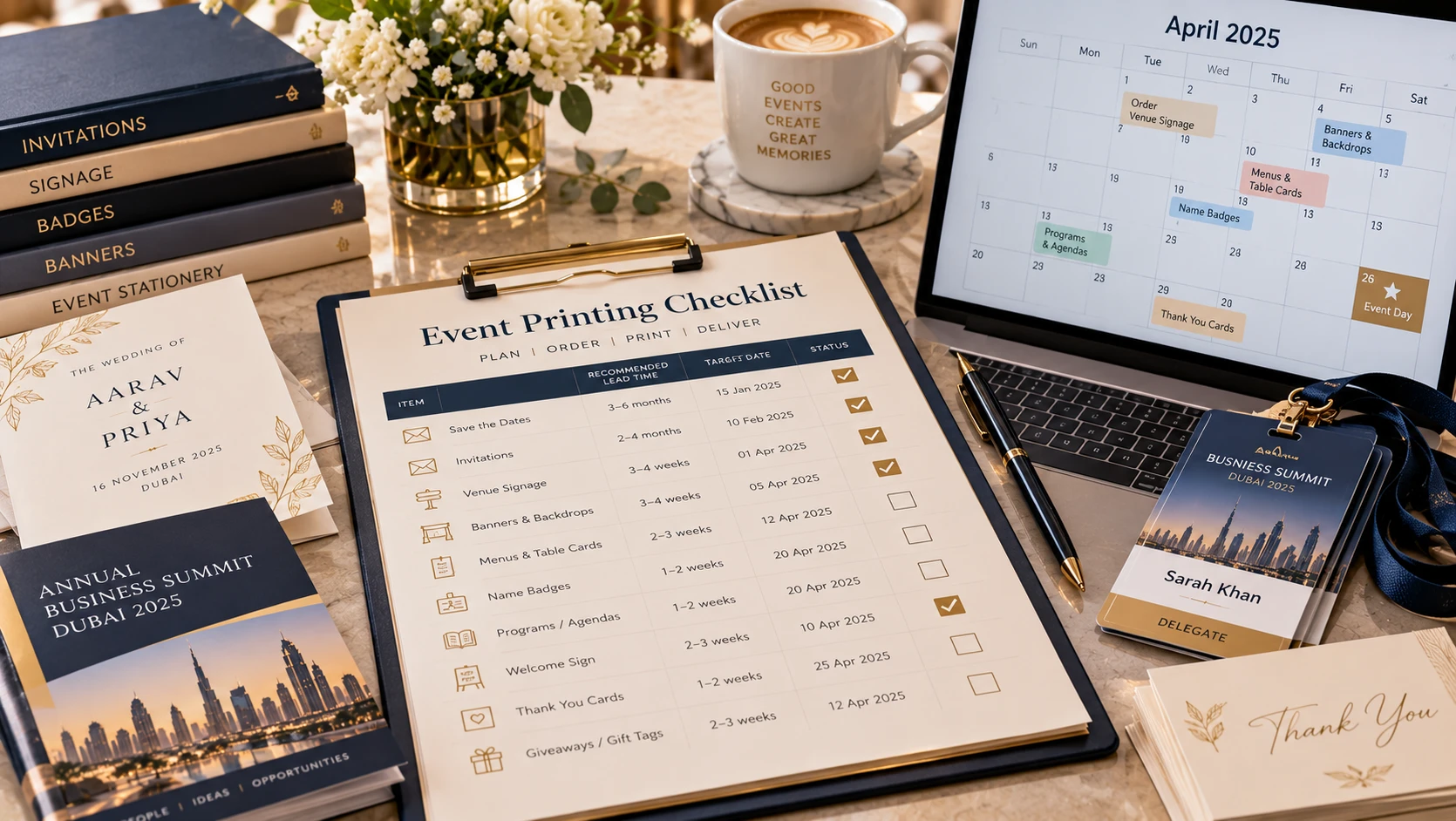
While every event is different, a general pattern holds across most: large-format and premium items need the most lead time, personalized items need to wait until data is confirmed, and simple flat prints, cards, and signage inserts can often be turned around quickest if artwork is ready.
Item type | General lead time | Examples |
Large-format graphics, premium stationery | Longest, several weeks | Backdrop banners, foil invitations, stage graphics |
Standard signage and print | Medium, one to three weeks | Roll-up banners, brochures, standard invitations |
Personalized items | Shortest before the event, but plan the process early. | Name badges, place cards, personalized programs |
Confirm exact production times for each item type when you request a quote, since this framework is a planning guide, not a fixed schedule.
Multi-Day and Multi-Session Events
For events spanning several days or multiple sessions, such as a multi-track conference or a wedding with several distinct functions, it helps to plan print by session rather than as one undifferentiated batch. Each session or day may need its own signage, its own set of name badges if attendance changes, or its own printed schedule. Breaking a large event into its component parts for planning purposes makes the overall print list far less overwhelming and easier to schedule against your supplier's production capacity.
Handling Last-Minute Changes
Even with careful planning, guest lists change, speakers drop out, and product details shift right up to an event. Build flexibility into your plan by separating what must be finalized early, large-format graphics with generic messaging, from what can be finalized late: name badges and small insert cards. Where possible, design large-format items without specific names or numbers that might change, so a late guest list change doesn't force a reprint of your most expensive item.
Weather and Venue Contingencies in the UAE
Outdoor UAE events need to account for heat and occasionally wind or dust when choosing print materials and finishes, particularly for signage and banners that will stand outside for an extended period. A material suited to a brief indoor exhibition may not hold up through a full day of direct sun at an outdoor wedding or launch. If your event has both an indoor and outdoor component, or a backup indoor venue in case of weather, plan signage that can work in either setting rather than assuming a single outdoor-only design. [CONFIRM: outdoor material suitability for extended UAE sun exposure]
Working With One Supplier Across the Whole Event
Briefing invitations, signage, badges, and any giveaways to one printer as a single project, rather than several separate suppliers, usually makes scheduling easier and keeps your branding consistent across every piece a guest or delegate encounters. It also means one point of contact managing your full timeline rather than juggling several deadlines with different suppliers.
Budgeting Across the Timeline
Event print budgets often split unevenly across the timeline: a larger spend early on invitations or large-format graphics, and a smaller, more flexible spend later onpersonalized items and any last-minute additions. Planning this split from the start, rather than discovering late in the process that the budget has run out before badges or place cards are ordered, keeps the full event print plan realistic.
After the Event: What to Keep and What to Retire?
Once an event ends, decide what's worth keeping for future use and what should be retired. A generic roll-up banner or backdrop with no date or specific details can often be reused for a future event, while personalized badges, place cards, and anything naming a specific date are single-use by nature. Keeping a simple record of which items were designed to be reusable saves time and cost the next time you plan a similar event, rather than starting the whole print list from scratch each time.
Common Event Printing Mistakes to Avoid
- Treating every item asneeding the same lead time. Large-format and premium items need far more notice than a personalized badge.
- Finalizing guest or delegate numbers too late for the printed items that depend on them.Build in a firm cutoff for names and numbers ahead of your production deadline.
- Ordering signage with specific numbers or names that could change. Keep large, expensive items generic where possible to protect against late changes.
- Using multiple suppliers without coordinating the timeline. One supplier managing the full print list is usually easier to plan around.
- Leaving invitations until too close to the date. Guests, especially those travelling, need enough notice to plan and respond.
Frequently Asked Questions
Q. How far ahead should wedding invitations be printed?
Ans. Several months ahead for international guests is common, with save-the-dates going out even earlier. Confirm exact lead times for your chosen stationery style.
Q. When should conference badges be finalized?
Ans. As close to the event as practical, once registrations are confirmed, since names often change up to the final days.
Q. Can large-format graphics be reused if a product launch is postponed?
Ans. Keeping messaging generic rather than date-specific makes reuse easier. Confirm this with your printer at the design stage.
Q. Should I use one printer for my whole event?
Ans. It generally simplifies scheduling and keeps branding consistent, though it depends on your specific event needs.
Q. What if my guest list changes after signage is ordered?
Ans. Design large-format items without specific names or numbers where possible, so late changes don't force a reprint.
Plan Your Event Print Timeline
Work backwards from your event date, and separate items that need early lead time from those that can wait for final numbers. For weddings, conferences, and product launches, see our Business Printing and Banners & Signage pages, or message us on WhatsApp with your event date and requirements.