How Local Print Shops in the UAE Can Get More Orders Without More Marketing
Local print shops in the UAE can grow order volume without a bigger marketing budget by focusing on three things: capturing overflow demand from other printers, being easier to reorder from than competitors, and tapping into partnership or referral relationships rather than relying solely on direct advertising. Marketing spend is one lever, but it's often not the fastest or most cost-effective one for an established local print shop with existing capacity and relationships.
This guide is written for independent and small-to-medium print shop owners in the UAE looking at practical ways to fill capacity and grow orders beyond a bigger ad budget.
Why Marketing Spend Isn't the Only Lever?
Most print shops default to marketing when they want more orders, sinceit's the most visible growth lever. But for a business with real production capacity and established equipment, the faster wins often come from the demand side rather than the spend side: capturing orders that are already out there and currently going elsewhere, rather than trying to create new demand from scratch through advertising.
This matters especially in a market like the UAE, where demand for printing is broad and constant, exhibitions, corporate stationery, and retail signage, but individual shops often only capture a fraction of the jobs that would genuinely suit their equipment and location.
Capturing Overflow Demand
Larger print buyers, agencies, corporate clients, and exhibition organizers frequently place orders that exceed what a single supplier can produce within their required timeframe, particularly during peak seasons like exhibition season or year-end gifting. This overflow demand often goes to whichever supplier the buyer already knows, rather than the shop best positioned to fulfill it. Building relationships with buyers and other suppliers who regularly generate more demand than they can handle alone is a direct way to capture orders without spending on advertising to find new customers from scratch.
Making Reordering Effortless
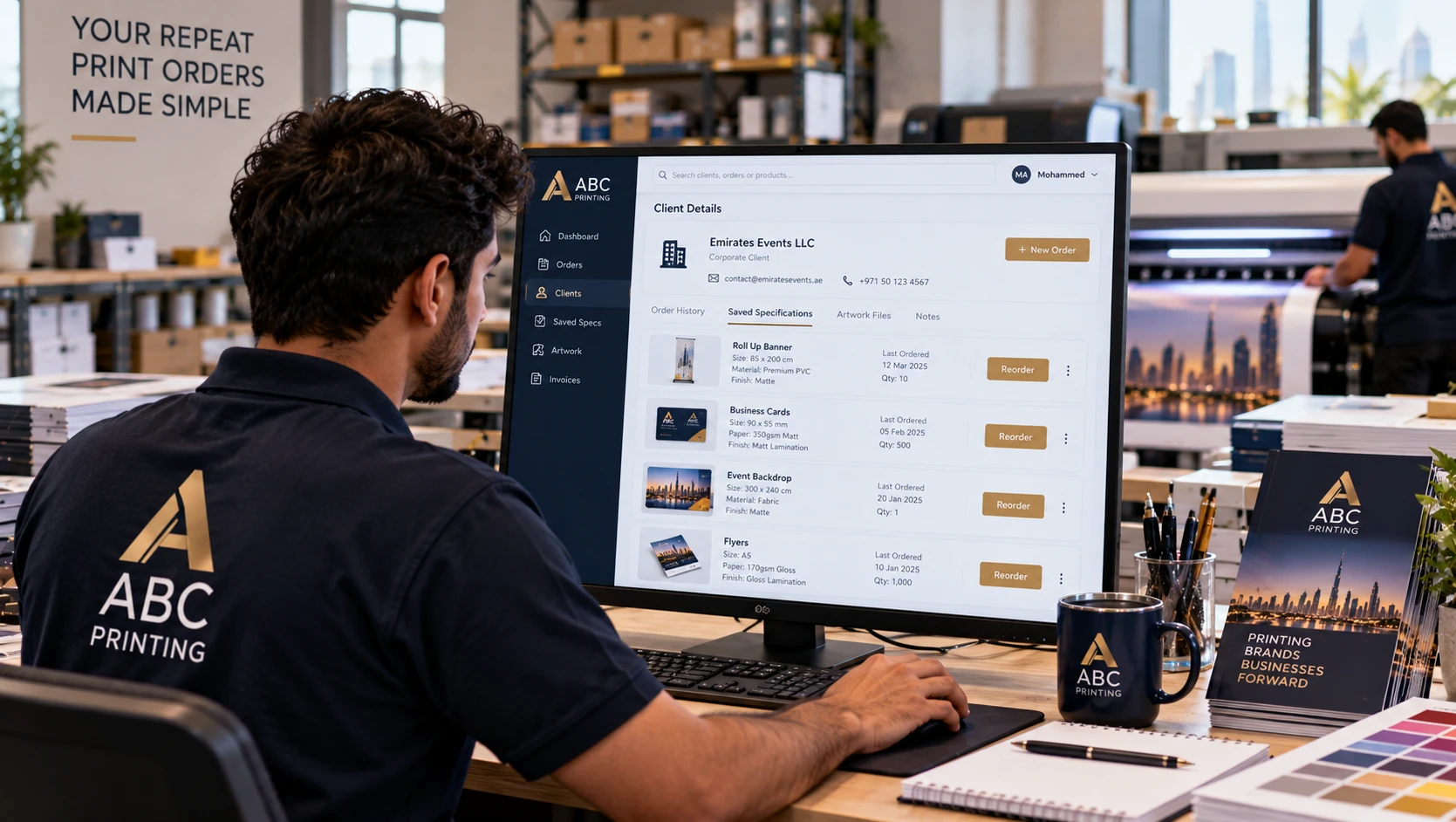
A significant share of print revenue for any shop comes from repeat orders, not first-time customers, so reducing friction in the reorder process has an outsized effect on order volume relative to the effort involved. Keeping clear, organized records of a client's previous specifications, stock, finish, quantity, and artwork file means a reorder can be confirmed in a single message rather than requiring the client to re-explain their requirements every time. Shops that make reordering effortless retain clients that a slower, more manual process would eventually lose to a competitor.
Partnership and Referral Relationships
Rather than competing directly for every customer, some of the most consistent order flow for a local print shop comes from partnerships with businesses adjacent to printing but not competing with it: designers, marketing agencies, event planners, and businesses with recurring print needs who'd rather refer the work than manage production themselves. A formal or informal referral relationship, where a partner sends print work your way and you handle production reliably, can generate steady order volume without either party spending on marketing to find each other.
Reliability as a Growth Strategy
In a market with many printing options, consistent reliability, meeting deadlines, producing accuratecolor matches, and communicating clearly when something changes are themselves forms of marketing, since satisfied clients refer work to others without being asked. A shop known for reliability within its existing client base often grows through word of mouth faster and more cost-effectively than one relying purely on advertising to attract entirely new customers who have no existing trust in the business.

Pricing Consistency and Its Effect on Trust
Buyers, particularly repeat corporate clients, notice when pricing shifts unpredictably between orders for the same specification. A shop that maintains consistent, explainable pricing builds a kind of trust that translates directly into repeat business and referrals, since the client isn't left wondering whether each quote reflects a fair price or simply what the shop thinks it can charge that week. This doesn't mean prices can never change; material costs do fluctuate, but communicating changes clearly, rather than letting clients discover a different price on their next order without explanation, protects the relationship that drives repeat volume.
Specializing Within a Broader Market
Rather than trying to serve every type of print job, some shops grow order volume by becoming known for a specific specialty, large format, a particular finish, or fast turnaround on a specific product within their local market. A buyer with a specific need is more likely to seek out a specialist than choose from a long list of generalist options, and specialising can also mean more efficient use of specific equipment rather than spreading capacity thin across every possible service.
Digital Presence That Supports, Rather Than Replaces, Relationships
A basic, accurate online presence, correct contact details, clear photos of past work, and an easy way to reach the shop still matter even when most growth comes from relationships rather than advertising. The goal isn't a large marketing budget behind it, but making sure that when a referral or a returning client looks the shop up, what they find reinforces the trust that led them there in the first place. A shop with strong relationships but an outdated or inconsistent online presence can quietly lose credibility with a new contact checking them out for the first time.
Working With a Partner Network
Some print shops choose to extend their capacity and order flow by working within a broader partner or platform network rather than operating entirely independently, taking on overflow production work from a shared pool of demand in exchange for reliable fulfillment. This kind of arrangement can bring in orders that wouldn't otherwise reach an individual shop, without that shop needing to build the marketing relationships or client base to generate that demand alone.
Training Staff to Support Client Retention
Order volume growth isn't only a management-level decision; it's affected by every interaction a client has with front-line staff taking orders, handling queries, or managing collection and delivery. A client who has a confusing or slow experience placing a reorder is more likely to try a competitor next time, regardless of how good the print quality was. Investing time in clear internal processes, how a repeat order is logged, how quickly a query gets answered, and how proofs are shared and approved pays off in retention just as much as the production quality itself.
What This Means in Practice?
Growing order volume without proportionally growing marketing spend usually means focusing on the relationships and processes already available to an established shop: existing client retention through effortless reordering, referral relationships with adjacent businesses, and capturing overflow demand that's currently going elsewhere. These levers tend to have a faster and more predictable return than a general advertising campaign, particularly for a shop with real production capacity that simply isn't fully utilized.
Seasonal Capacity Planning
UAE print demand isn't evenly spread across the year: exhibition season, year-end gifting, and Ramadan all create sharp spikes in demand, while other periods are quieter. A shop that plans capacity around these known peaks, rather than treating every month the same, can capture more of the peak-season overflow business discussed earlier, since buyers turned away during a busy period rarely wait around; they simply find another supplier. Understanding your own quiet periods also opens a window to focus on the relationship-building and process improvements that are harder to prioritize when the shop floor is at full capacity.
Common Growth Mistakes to Avoid
- Assuming more orders require more ad spend. Existing relationships and processes often hold untapped growth potential first.
- Making reordering harder than it needs to be. A client who has to re-explain their order every time is more likely to try a competitor.
- Ignoring referral relationships with adjacent businesses. Designers, agencies, and event planners are a consistent source of print work if the relationship is built.
- Trying to serve every type of job equally. Specializing can attract more focused, higher-value demand than trying to be a generalist for everyone.
- Overlooking overflow demand from other suppliers. Larger buyers regularly need more capacity than a single supplier can provide.
Frequently Asked Questions
Q. Is marketing spend the fastest way to grow order volume?
Ans. Not always. For an established shop with existing capacity, relationships and reorder processes often deliver faster, more cost-effective growth than advertising.
Q. How can I make reordering easier for my clients?
Ans. Keep organized, easily retrievable records of past specifications so a reorder can be confirmed quickly without the client re-explaining details.
Q. Should a print shop specialize or stay a generalist?
Ans. Specializing in a specific product, finish, or turnaround can attract more focused demand, though it depends on your market and equipment.
Q. What is overflow demand, and how do I capture it?
Ans. It's demand exceeding another supplier's capacity, often during peak seasons. Building relationships with buyers and other suppliers is one way to capture it.
Q. Is a partner network worth considering for a small print shop?
Ans. It can extend order flow beyond what independent marketing efforts would generate. Consider whether the fit works for your business and capacity.
Explore Partnership Opportunities
If capturing overflow demand and working within a broader partner network is something your print shop wants to explore, see how the model works in our white-label printing guide, or contact Print Emirates to discuss how this could work for your business.