Types of Paper Printing: A Complete Guide to Categories, Stock and Finishes
Paper printing sounds like it should be a simple term, ink on paper, but in practice it covers an enormous range of products, methods and materials. A business card and a product catalogue are both paper printing, but they're produced differently, on different stock, with different finishes, for entirely different purposes. Understanding the categories underneath that one broad label makes it easier to know what to actually ask for, instead of guessing at half-familiar terms.
This guide covers what paper printing means, the main production methods, the major product categories, paper stock, and the finishes that change how a piece looks and feels.
What Paper Printing Actually Means?
At its core, paper printing is the process of transferring an image, text or design onto paper using ink, toner or a similar pigment, through a mechanical or digital process. That's a broad definition on purpose, since it covers everything from a single-page flyer run off on a digital press to a large offset run of ten thousand brochures.
What separates paper printing from other forms, garment, packaging on rigid materials, large-format vinyl, is the substrate: paper or a paper-based stock rather than fabric or plastic. That sounds narrow, but paper covers so much variety in weight, texture and coating that "paper printing" ends up being one of the widest categories in the industry.
How Paper Printing Actually Works: The Main Methods!
Before the categories, it helps to understand how products are actually produced, since the method affects cost, turnaround and what's realistic in small quantities.
Offset Printing
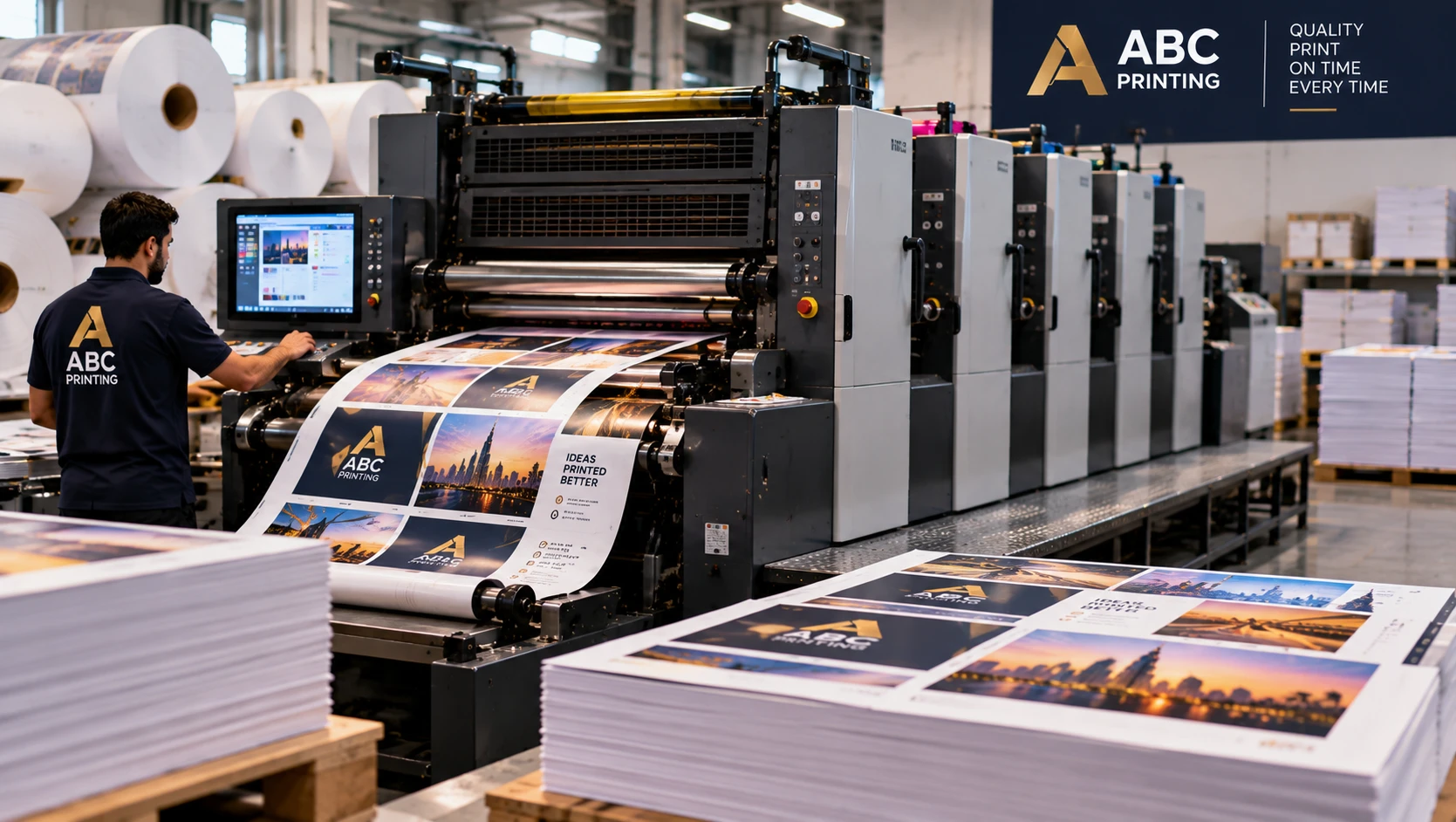
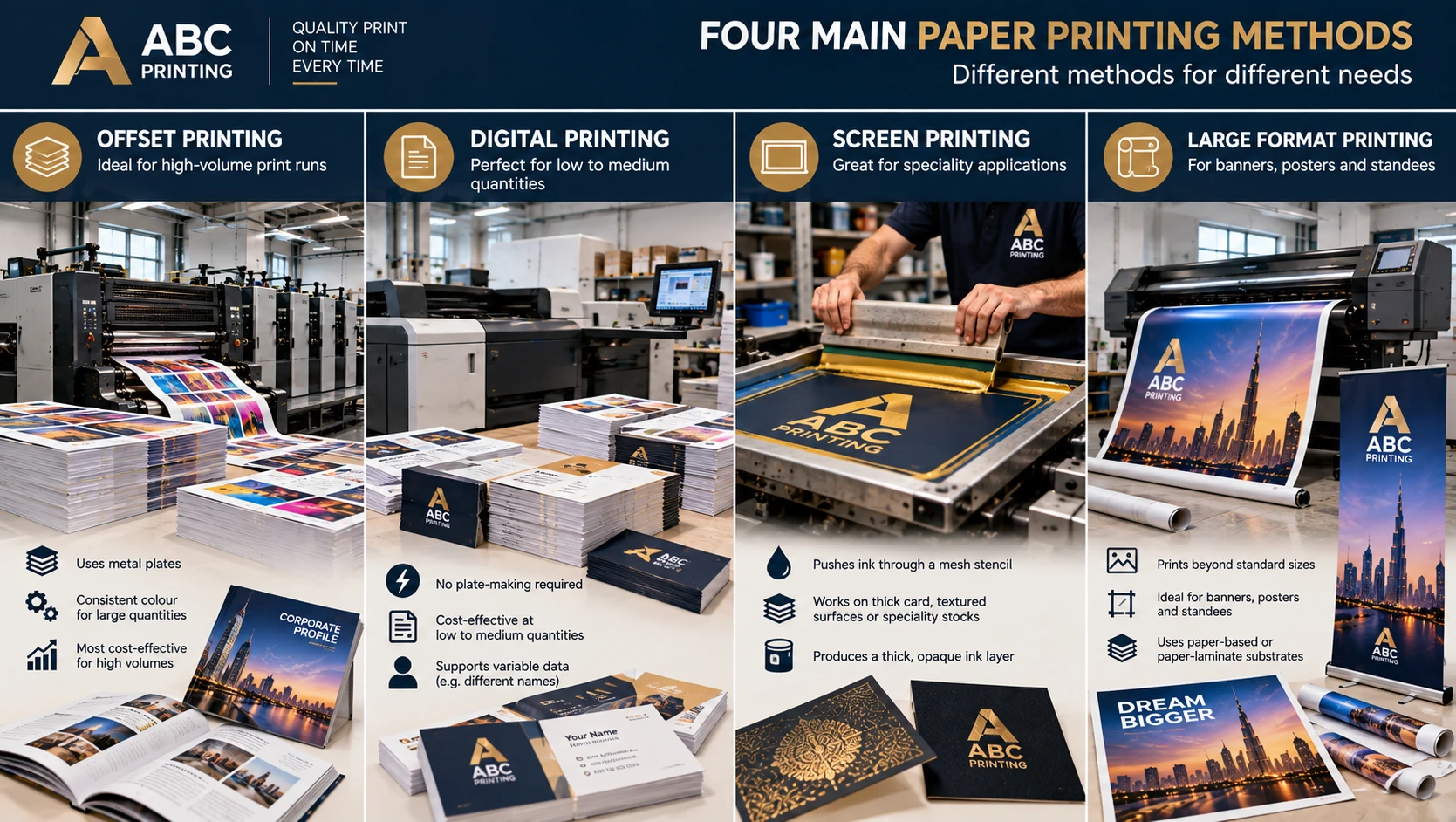
Offset uses metal plates to transfer ink onto a rubber blanket, which then transfers the image onto paper. It's the traditional method for high-volume runs, producing very consistent colour across large quantities. The trade-off is setup: creating plates takes time and cost upfront, so offset only makes sense at higher quantities, thousands rather than hundreds. See our offset vs digital printing guide for a full comparison.
Digital Printing
Digital printing skips the plate-making step entirely, similar in principle to a high-end office printer built for commercial volume. This makes it far more economical at low to medium quantities, and it allows variable data, different names on each piece in the same run, which offset can't easily do. The quality gap has narrowed significantly, though very large runs still favour offset on cost.
Screen Printing
Screen printing pushes ink through a mesh stencil onto the surface below. It's used for speciality applications: thick card stock, textured surfaces, or where a very opaque ink layer is needed that offset or digital can't achieve.
Large Format Printing
Large format, or wide format, means printing beyond what a standard press handles: banners, posters, standees. On paper-based stock rather than vinyl or fabric, this falls under the paper printing umbrella too. See Roll-Up Banners and Foam Board Panels.
The Main Categories of Paper Printing!
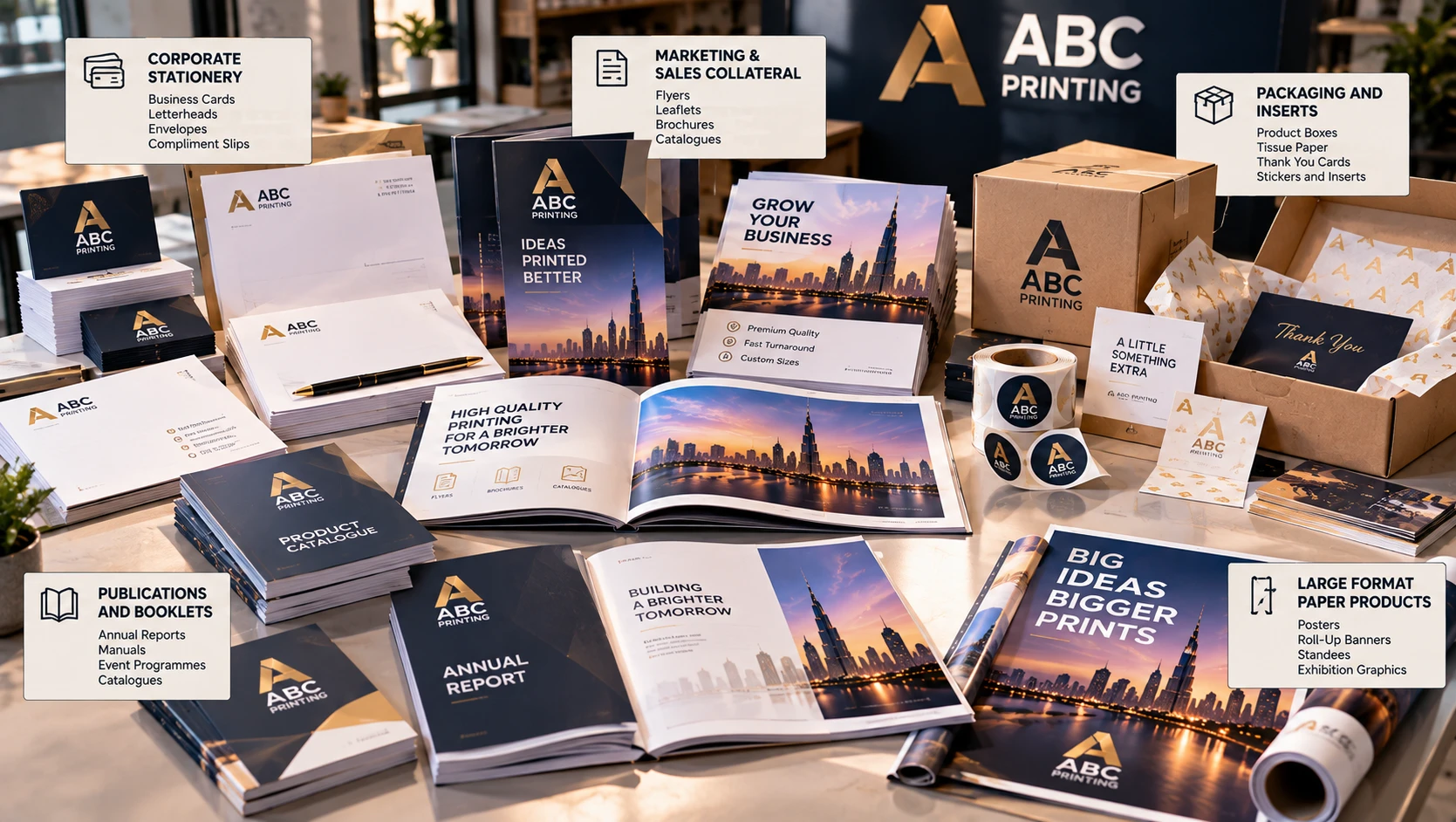
With the methods covered, here's how paper-printed products break down by purpose. Most businesses end up needing more than one of these categories, even if they only think of themselves as needing "printing" for one specific thing.
1. Corporate Stationery
This is the category most people think of first: business cards, letterheads, envelopes and compliment slips. Typically low-volume, high-frequency items ordered repeatedly over a company's life, carrying a disproportionate amount of brand impression relative to their size. See Business Cards, Letterheads and Envelopes.
2. Marketing and Sales Collateral
Flyers, leaflets, brochures and catalogues fall here. Built for distribution, handed out at events, mailed or left in reception areas, so they need to communicate quickly and hold up to being carried around, often in higher volumes than stationery. Formats vary too: single-sheet flyers, bi-fold and tri-fold brochures, saddle-stitched booklets for longer catalogues. See Flyer Printing and Brochures & Catalogues.
3. Packaging and Inserts
Not all packaging is rigid cardboard; a significant amount of paper printing goes into inserts, tissue paper, thank-you cards, and lighter elements that sit inside or alongside a primary package. This category has grown with the rise of e-commerce, where the unboxing experience has become part of the product itself. See Custom Product Boxes and Paper Bags.
4. Publications and Booklets
Multi-page printed material, annual reports, manuals, event programmes, falls into its own category because of binding and page-count considerations. Saddle-stitching, perfect binding and wire-o binding are the main options, and the choice affects both cost and how the piece is used: whether it needs to lie flat, survive heavy handling, or simply look polished for a one-time presentation. See Brochures & Catalogues for binding options.
5. Large Format Paper Products
Roll-up banners, posters and standees printed on paper-based or paper-laminate substrates sit here, bridging traditional paper printing and large-format signage. They're especially relevant for exhibitions and events, where a stand needs graphics that are portable and quick to produce, without the heavier vinyl or fabric substrates used for permanent signage. See Roll-Up Banners.
6. Labels and Stickers
Paper-based labels and stickers, as opposed to vinyl or synthetic alternatives, are used heavily in retail, packaging and product branding. They're often produced digitally because of the variable sizes involved, and they sit at a lower per-unit price than stationery or collateral at much higher quantities. See Stickers & Labels.
Types of Paper Stock!
Paper stock is where most of the practical decision-making happens, usually described along two axes: weight and coating.
Weight (GSM)
GSM, grams per square metre, measures how heavy and thick a paper stock is. Lighter stocks, 80 to 150gsm, suit flyers, letterheads and internal documents. Mid-weight stocks, 170 to 250gsm, are common for brochure covers and postcards. Heavier stocks, 300gsm and above, hold their shape and feel substantial, business cards being the clearest example. See our full GSM guide for a product-by-product breakdown.
Coated vs Uncoated
Coated stock has a surface layer, matt, gloss or silk, applied during manufacturing, which affects how ink sits and how vivid colours appear. Uncoated stock has no such layer, so it absorbs ink slightly into the fibres, producing a softer, more natural look, and it's easier to write on, which matters for letterheads or anything needing a signature.
Speciality Stocks
Kraft paper gives a natural, brown-toned look tied to sustainability messaging; recycled stock suits eco-conscious businesses; cotton and linen stocks add visible texture, often used for premium stationery. See our eco-friendly printing guide for sustainable stock options.
Finishes: What Happens After Printing?
Finishing is a separate step from printing, and it's where most of the visual and tactile difference between similar products comes from.
Matt lamination applies a flat, non-reflective coating that reduces glare and fingerprints while keeping colours sharp. Gloss lamination does the opposite, adding shine and more vivid colour at the cost of visible fingerprints. Soft-touch lamination adds a velvet-like texture, changing how a piece feels rather than just how it looks. Spot UV applies a glossy, raised coating to specific elements only, usually a logo, creating contrast against a matte base. Foil stamping applies a thin layer of metallic or coloured foil for a reflective, tactile effect. Embossing and debossing raise or press elements into the paper itself, adding a three-dimensional quality.
For the full comparison, see our matte vs gloss vs soft-touch lamination guide. Not every finish suits every product: a dense, text-heavy brochure page rarely benefits from spot UV or foil, while a business card has room for these finishes to make an impact.
How to Choose the Right Type for Your Project?
There's no single "best" combination; the right choice depends on three questions. How will it be used? A card handled daily for months needs a heavier stock than one filed away once. How many do you need? Below a few hundred units, digital is almost always more economical; above a few thousand, offset starts to close the gap. See ouroffset vs digital printing guide for where that crossover sits. What impression does it need to create? A soft-touch finish or foil signals a different intent than plain matte, and that's a legitimate design decision, not just an upsell.
Common Misconceptions
- "Thicker paper always means better quality." Weight and quality aren't the same thing. A well-printed 150gsm flyer looks better than a poorly printed 400gsm one; weight should match the use case, not act as a proxy for quality.
- "Digital printing is lower quality than offset." True a decade ago, far less true now. At lower quantities, digital output is visually indistinguishable from offset to anyone but a trained eye.
- "Glossy finishes always look more premium." Gloss reads as premium in some contexts and cheap in others. A soft-touch or uncoated finish often reads as more sophisticated for boutique retail and design-led brands.
Getting Your Files Ready
Whichever category and finish you choose, the print will only be as good as the file behind it. Correct bleed, resolution and colour mode matter across every category here, from a business card to a large-format banner. See our print-ready artwork guide before sending a file to production.
Frequently Asked Questions
Q. What is the difference between offset and digital paper printing?
Ans. Offset uses metal plates and suits high-volume runs where setup cost spreads across many units. Digital skips that step and is more economical at low to medium quantities. See our offset vs digital printing guide.
Q. What GSM should I choose?
Ans. It depends on use. Lighter stocks suit flyers and letterheads, heavier stocks suit business cards and anything needing to feel substantial. See our GSM guide for a breakdown by product.
Q. Is coated or uncoated paper better?
Ans. Neither is universally better. Coated stock produces sharper colour and suits photography; uncoated has a natural feel and takes pen ink more readily, which matters for letterheads.
Q. Which finish should I choose?
Ans. It depends on handling and the impression you want. Matt suits everyday use, gloss suits vibrant color, soft-touch and foil suit a premium feel. See our lamination guide.
Q. Does paper printing include banners and large-format signage?
Ans. Paper and paper-laminate substrates cover some large-format products, such as posters, though vinyl and fabric are also common for signage. See our large-format banner guide.
Get Started With Your Paper Printing Project
Whatever category you're ordering, choosing the right method, stock and finish upfront saves cost and avoids a reprint. See our Business Printing page or message us on WhatsApp with your project and quantity.